Showing posts with label problem solving. Show all posts

Wednesday, 11 February 2015

Awesome Day, Awesome Learning!

Today was one of those rare days; one of those days that appears ordinary at first glance. No special guests, no crazy activities, not even a library period or a Music class. Just 14 students and their teacher, working hard, learning and encouraging each other. 

But as we gathered for prayer at the end of the day and took a moment to reflect, it was clear; awesome day, awesome learning! 

To begin to document a day in grade 1 would take paragraph upon paragraph, so I'll offer just a few peeks into our "average" little Wednesday. 

We have been working with numbers up to 100, and today we were reviewing skip counting by 10's. Here is the Math Journal problem the students tackled (and conquered!)

Students were encouraged to show their thinking in whatever way suited them, and they rose to the challenge! 


Please look for opportunities to practice skip counting:

  • by 10's to 100
  • by 2's to 20
  • by 5's to 100

We have continued to practice applying reading comprehension strategies in our language lessons. Remember when we first started making text-to-self connections? 

Last week we focused on making predictions. It is important to make predictions before and during reading. It helps students monitor their understanding of a story, while encouraging them to think ahead. 
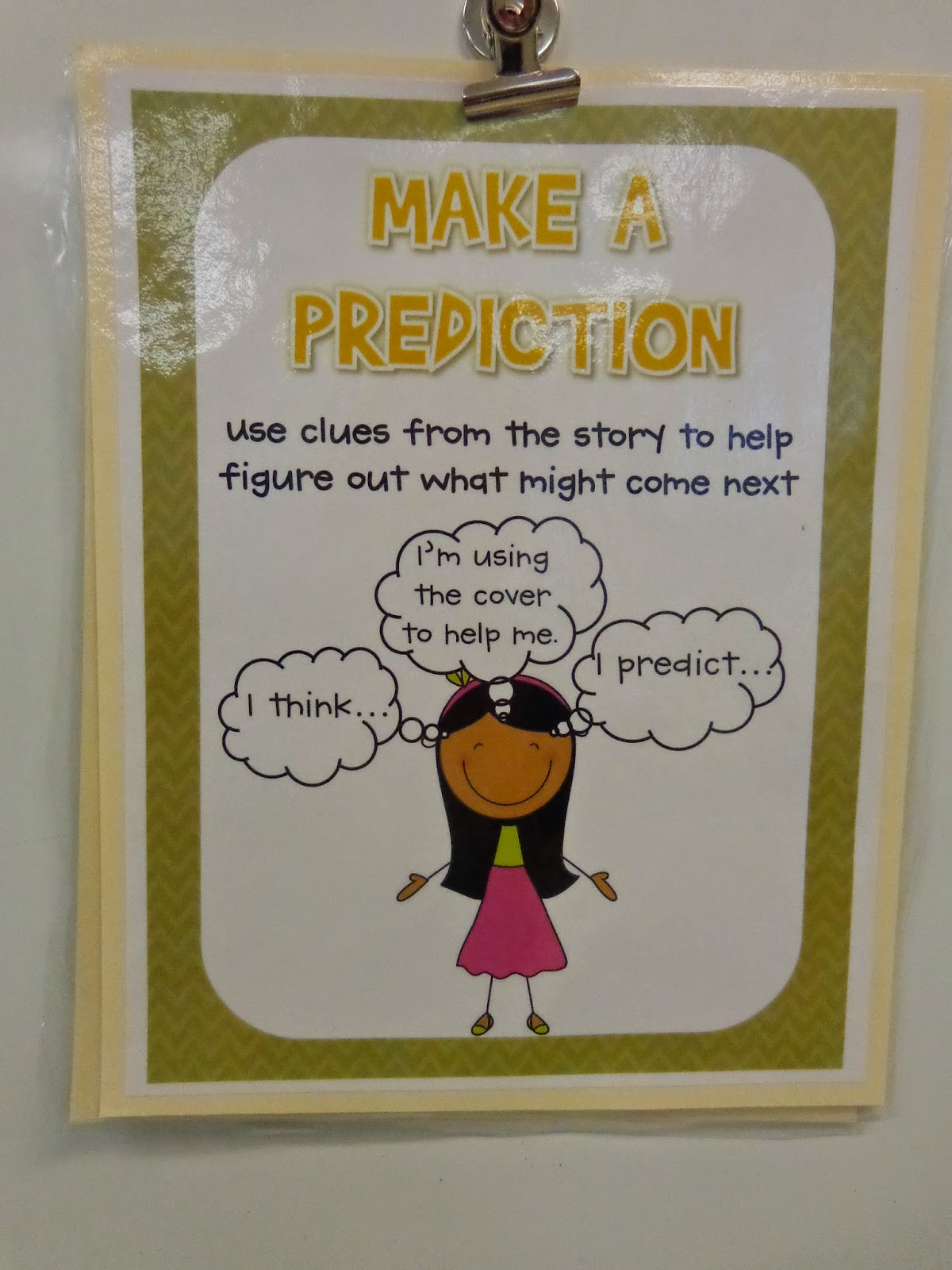


We've read several stories, making predictions before and during reading, however today we shook up our prediction mini-lesson! We watched a fun little clip about a pig who sees a cookie jar sitting high on top of the fridge. The cookies are just out of reach! The boys and girls LOVED making predictions about how he might get the cookies!

"I predict he is going to kick it." (the fridge)

"I predict he gets a ladder to get the cookies."

We watched this clip, pausing it to make frequent predictions:


Thank you for sharing your children with me each day. We'll see what tomorrow brings ... never the same day twice!

Prediction poster from the Comprehension Strategy Poster collection made by A Year of Many Firsts.  Prediction mini-page from Kindergarten Boom Boom. 


Tuesday, 21 October 2014

Problems with our Veggies!

We continue to explore numbers to 20 and we were presented with a challenge today!


Why are dads always so tricky?


The students got to work! Some grabbed a pile of counters, some chose coloured construction paper, and others began drawing pictures. This group doesn't back down from a challenge!


There is no right way to arrive at the answer, nor is there a single correct answer. Here are a few responses:


As we continue to work with numbers to 20 and then move on to addition and subtraction, the children will be encouraged to choose how they will solve a problem, whether it be with a picture, manipulatives, or other strategy. 


Way to count carefully, boys and girls!


Monday, 22 October 2012

Problematic Peas and Carrots

We like to joke in our classroom that our brains get really hot when we are thinking and working hard! Although it was a chilly day, we had warm brains in our Math class!

We continue to explore numbers to 20. Today we were presented with a problem:


The children collaborated to find a solution to this open-ended problem. Manipulatives (e.g. counters, blocks, bean bags), whiteboards, and chart paper were all on hand. The children were encouraged to use objects, pictures or numbers to explain their thinking.

Here are a few of the final solutions the children recorded in their Math Journals:


Did you notice that there is no one right answer? The children enjoyed the fact that there were many "right answers" to this problem.

When solving problems, the children are encouraged to draw functional pictures, not fancy ones. In fact, while pictures should be organized and legible, it is not uncommon for scribbles or arrows to be scattered across their work as they carefully count and double-check their answer with the information in the problem.

Many more open-ended problems are to come!