Showing posts with label indigenous. Show all posts

Tuesday, 29 September 2026

Walking Together: Truth & Reconciliation

Learning Canada’s true history means listening with open hearts to the voices and experiences of First Nations, Métis, and Inuit Peoples. As we continue our journey of Reconciliation, we are learning how to listen, understand, and care for one another, just as Jesus calls us to do. Over the past few days, we took time to learn, reflect, ask questions, and grow in kindness, understanding, and respect.


Reading Phyllis Webstad’s With Our Orange Hearts led to heartfelt conversations about belonging and the importance of every child feeling safe and valued. We brainstormed words that describe how children should feel at school, and created a beautiful collaborative display.


Inspired by the Cree calendar book When the Trees Crackle with Cold, we became “nature trappers,” noticing God's beauty around us with new eyes. Our Treaty 6 land is a beautiful gift in all seasons!

The Cree story Awasis and the World-Famous Bannock inspired us to try making bannock ourselves! The story has many Cree words that we practiced saying. What a fun way to measure, work as a team, and enjoy a tasty, traditional treat!

Delicious!


Father Jim popped in during our weekly clergy visit. He reminded us that we are infinitely loved by God and created unique and special. Father Jim encouraged us to look for Jesus in everyone we meet.


We crafted beautiful glowing orange lanterns, reminding us that we all hold immense value. Every child matters.

Our journey of learning about reconciliation and Indigenous culture is just beginning. We look forward to continuing to grow in understanding together.


Tuesday, 24 February 2026

Our Wintry Wilderness Adventures

We spent a spectacular day learning at the Strathcona Wilderness Centre!

Indigenous First Families Program

Our morning kicked off with the Indigenous First Families program, led by the wonderful Nadine. We stepped back in time to explore how the Inuit of the Arctic, the Plains First Nations, and the Woodland First Nations of Eastern Canada thrived long ago. Without stores like Costco, survival relied on expert hunting and a deep sense of community, where families shared everything from food to childcare.


While children didn’t attend formal schools, they were always learning! They learned hunting, cooking, and sewing from their elders. It was a life of responsibility and teamwork. Every job helped the family survive.

❄️ The Inuit: Life in the North

In the Arctic, the Inuit survived the cold by living in igloos and making tools. We got a close look at ring seal fur, used to create warm clothing and kamiks (shoes). One student even tried on a cozy seal fur parka! We learned how tough, creative and resilient the Inuit were.


🌾 The Plains First Nations: Hunters & Celebrators

The Plains First Nations followed the buffalo, living in tipis that could be moved. Nadine shared their vibrant culture of celebration, particularly the "powwow." We heard an elaborate fan that sounded like birds flapping. One lucky student dressed in traditional regalia, including a bone-and-bead choker, moose moccasins, and a protective breastplate. We even saw a replica headdress, where each feather represents a brave or kind deed.


🌲 The Woodland First Nations: Masters of the Forest

The Woodland First Nations lived near the Great Lakes, where they became incredible hunters and navigators. They used the birch trees around them to build canoes for traveling. After learning so many facts, the students were thrilled to handle the artifacts themselves. Feeling the silky furs and pelts was an absolute highlight!


Creativity and Play

To wrap up the morning, the students tapped into their own creativity! They designed fans decorated with nature-inspired scenes like rainbows and animals. We ended the morning with several traditional games. Though the rules were simple and the pieces were few, they were a challenging and high-energy hit!


Nature Scavenger Hunt

After a quick lunch, we bundled up and headed outside to experience God’s beautiful creation! Did you know we brought our own detective tools? Our five senses! Inspired by the book I Wonder, we set off on the trails, using our eyes, ears, noses, hands, and even our sense of smell to explore the world around us.


We shared a perfect day together! What a blessing to be able to take our learning beyond the classroom!

Monday, 29 September 2025

Walking the Path of Reconciliation

Understanding the true history of Canada begins by listening to the voices of First Nations, Métis, and Inuit Peoples. As part of our commitment to Reconciliation, we dedicated time to learn, reflect, and grow with open hearts.


Storytelling guided much of our learning. We went out on the land, and through the walking trail tale Sometimes I Feel Like an Oak, we connected our emotions with nature as we journeyed around the schoolyard.


The Cree story Awasis and the World-Famous Bannock inspired us to try making bannock ourselves! It was a fun way to measure, work as a team, and enjoy a tasty, traditional treat!

Inspired by the Cree calendar book When the Trees Crackle with Cold, we became “nature trappers,” noticing God's beauty around us with new eyes. 

One story that resonated with us was My Heart Fills with Happiness, written in both English and Plains Cree by a Canadian author and illustrator. It highlights the simple joys in life. We also paused to remember that many Indigenous children in Canada’s history, especially those who were taken from their families to residential schools, often did not have hearts filled with happiness. This made the message of the book even more powerful. After reflecting on what fills our own hearts with happiness, we let our creativity shine with water colour paints!


Reading Phyllis Webstad’s
With Our Orange Hearts led to heartfelt conversations about belonging and the importance of every child feeling safe and valued. We crafted beautiful glowing orange lanterns.


Lighting them together in prayer at assembly today was a powerful moment of hope, remembrance, and unity.


Our journey of learning about reconciliation is just beginning. We look forward to continuing to grow in understanding together.


Thursday, 26 September 2024

Every Child Matters: Truth & Reconciliation

Learning about the truth of our history from First Nations, Métis, and Inuit knowledge keepers is an important part of the path to Reconciliation. This week we took time each day to learn and grow with an open heart and open mind.

We have already begun learning about Indigenous people of Canada, and this was an excellent way to understand the meaning of the word "Indigenous":


The tradition of storytelling is vital in Indigenous culture, and our week of learning is reflected in the many stories we read. 


We read a beautiful Anishinaabe story called Sometimes I Feel Like a Fox. Being connected to the land and nature is woven through Indigenous culture. We reflected on the qualities portrayed by various animals in this book and shared which animal meant the most to us. 


We shared the Cree book Awasis and the World Famous Bannock, and then we gave this traditional recipe a try! Measuring a teamwork played a big part in making bannock ...

... but tasting was the highlight!

Out on the land, we read the Cree story When the Trees Crackle with Cold, a book exploring seasonal changes. Then we got our "nature trappers" and hunted for beauty in our forest!

We discussed the value of each person. We are made with love and intention, and are all children of God. We had some challenging and insightful conversations as we shared Phyllis Webstad's book With our Orange Hearts. We discussed residential schools and reflected on how students should feel in school. 


Then we carefully created orange lanterns that can shine and remind us how important every child is. 
We were so proud to light them and gather in prayer:


Though our week has ended, learning the truth about Canada's history and deepening our understanding of the First Nations, Metis and Inuit cultures has only just begun. 


Friday, 29 September 2023

Every Child Matters

Learning about the truth of our history from First Nations, Métis, and Inuit knowledge keepers is an important part of the path to Reconciliation. This week we took time each day to learn and grow with an open heart and open mind.

We have already been learning about Indigenous people, and this was an excellent way to understand the meaning of the word "Indigenous":

The tradition of storytelling is vital in Indigenous culture, and our week of learning is reflected in the many stories we read. 

We read a beautiful Anishinaabe story called Sometimes I Feel Like a Fox. Being connected to the land and nature is woven through Indigenous culture. We reflected on the qualities portrayed by various animals in this book and shared which animal meant the most to us. 


We shared Awasis and the World Famous Bannock! Did you try the bannock recipe together at home?


Out on the land, we read the Cree story When the Trees Crackle with Cold, a book exploring seasonal changes. Then we got our "nature trappers" and hunted for beauty in our forest!


We discussed the value of each person. We are made with love and intention, and are all children of God. We had some challenging and insightful conversations as we shared Phyllis Webstad's book With our Orange Hearts. We discussed residential schools and reflected on how students should feel in school. 

Then we carefully created orange lanterns that can shine and remind us how important every child is. 

We were so proud to light them in the Chapel and gather in prayer:

Though our week has ended, learning the truth about Canada's history and deepening our understanding of the First Nations, Metis and Inuit cultures has only just begun. 


Friday, 27 January 2023

Wilderness Adventures: First Families & Snowshoeing

On Friday, we spent the day at the beautiful Strathcona Wilderness Centre! 

Our morning kicked off with the Indigenous First Families program, led by Nadine. We explored how families used to live a long time ago. We learned so much about the Inuit people of the Arctic, the Plains First Nations, and the Woodlands First Nations of Eastern Canada. 


Nadine began by explaining why the first families in Canada thrived. There were no stores like Costco, so these people were excellent hunters. They lived in community, supporting each other in many ways, such as sharing food and child care. The children had chores and responsibilities that helped their families survive, too. While they didn't attend school, children learned from elders how to hunt, make clothing, cook, and so much more. 


The Inuit

The Inuit lived in the north, often in igloos. Nadine shared many fascinating items with us from the Inuit people. We touched a ring seal fur. Fur from ring seals was used to make clothing and "kamiks", or shoes. One student tried on a cozy seal fur parka, which is very warm, as well as caribou kamiks! He gave snow goggles a try, too, which are wooden glasses with thin slits that protect the eyes from the sun's glare off the snow. 


The Plains First Nations

The people of the plains would follow the buffalo and hunt them. They often lived in tipis, which could be quickly and easily set up, taken down, and transported. 

Nadine shared that the Plains First Nations were known for their love of celebrations, or "powwows". She showed us an elaborate fan that the women would use, and when it waved it sounded as though birds were flapping overhead! She dressed up one of our students in some traditional celebratory clothing. She wore a bone and bead choker, beaded moose moccasins, a breast plate (often used as chest protection during battle), and a moose skin wrap. We saw a replica headdress. Traditionally it is made of eagle feathers (although this one was not), and each eagle feather on a headdress represents a brave or kind deed. 


The Woodland First Nations


The Woodland First Nations lived in the forests of eastern Canada around the Great Lakes. They were amazing hunters. Nadine shared a variety of beautiful furs with us. 

The Woodland First Nations lived near many lakes, and made canoes from the bark of birch trees so they could travel through the water. 
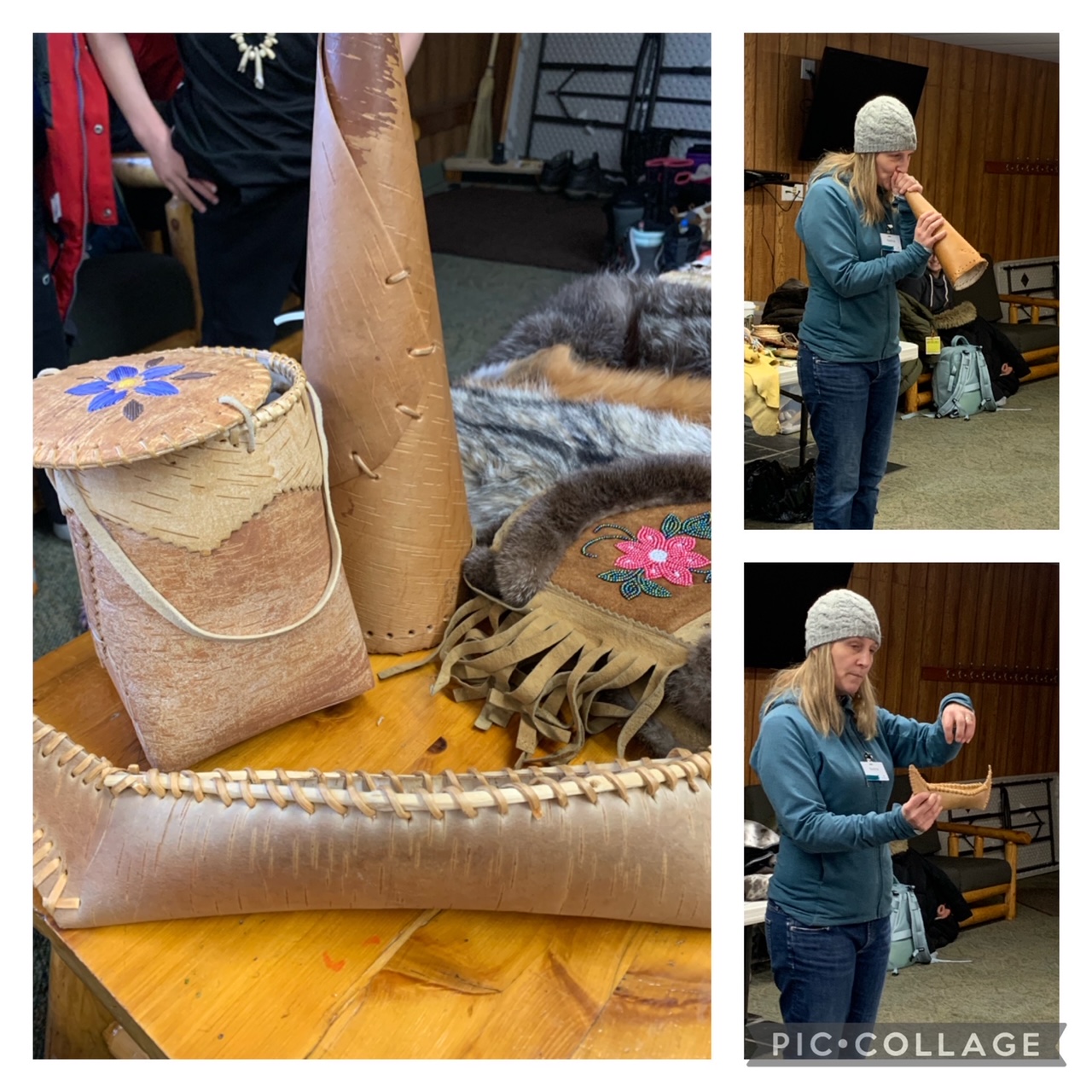

After hearing so many interesting facts and seeing the amazing collection of artifacts, it was time to touch them ourselves! The students most enjoyed feeling the silky furs and pelts!


Then the students were challenged to get creative! Using paper, feathers, and markers, the children got to work designing their own fans. They were encouraged to draw scenes from nature, and many drew rainbows, flowers, animals and more!

Perhaps the highlight of the morning was learning several of the games the children would have played. While they were simple, with few rules or game pieces, they were challenging and fun for everyone!  

After a quick lunch, we jumped into snowshoeing! We learned that Snowshoe Hares have wide feet that snowshoes are designed after. 


Then we snapped up our own snow shoes and headed out! We played relays, tag games, and Simon Says, and then headed out on a walk in search of signs of animals. 


It was a beautiful day of learning!

Thursday, 29 September 2022

Every Child Matters: Truth & Reconciliation

Learning about the truth of our history from First Nations, Métis, and Inuit knowledge keepers is an important part of the path to Reconciliation. This week we took time each day to learn and grow with an open heart and open mind. 


The tradition of storytelling is vital in Indigenous culture, and our week of learning is reflected in the many stories we read. 

We read a beautiful Anishinaabe story called Sometimes I Feel Like a Fox. Being connected to the land and nature is woven through Indigenous culture. We reflected on the qualities portrayed by various animals in this book and shared which animal meant the most to us. 


We shared Awasis and the World Famous Bannock! Did you try the bannock recipe together at home? 


Out on the land, we read the Cree story When the Trees Crackle with Cold, a book exploring seasonal changes. Then we got our "nature trappers" and hunted for beauty in our forest!


Inspired by beautiful Metis beading and the four colours in the medicine wheel, we made dot art celebrating our own uniqueness! These handprint pieces reinforce the message that "every child matters". 


We discussed the value of each person. We are made with love and intention, and are all children of God. We had some challenging and insightful conversations as we shared Phyllis Webstad's new book With our Orange Hearts. We discussed residential schools and reflected on how students should feel in school. We put these special words on an orange heart to post in our chapel. 

While the week concluded in our classroom family wearing orange, learning the truth about Canada's history and deepening our understanding of the First Nations, Metis and Inuit cultures has only just begun.